Showing posts with label Broughtonthwaite Mates. Show all posts

Wednesday, 1 November 2017

It's One Hundred and One Years Since The Pennine Fusiliers Disappeared


Today sees the one hundred and first anniversary of the disappearance of the 13th Battalion of the  Pennine Fusiliers from the Somme. Popular myth has it that they were transported to another world although few today, outside of the community the battalion came from, have heard the story.
    Repeated representations have been made to the government by the Joanne Donovan, M.P. for Broughtonthwaite South, but the official response remains the  same, ‘It is not in the national interest to release documents relating to the Harcourt Event.’ Relatives and descendants of the missing have been waiting over a century to find out what happened to their family members and loved ones that fateful day.
     
- Broughtonwhwaite Mercury, November 1st, 2017
   
   
    The Harcourt Crater is one of the greatest mysteries of World War One, along with the Angel of Mons, the Phantom Archers and the Crucified Canadian. At nearly half a mile wide, it was reputed to be the largest man-made crater on the Western Front. The official explanation was that German mines dug under the British positions in the Harcourt Sector of the Somme were filled with an experimental high explosive before being detonated on the morning of November 1st 1916, resulting in the loss of over nine hundred men of the 13th Battalion of the Pennine Fusiliers.
    Indeed this was the accepted explanation until a decade later, when, in the mid- 1920s, a French farmer ploughing his field, dug up, amongst the unexploded shells, several mud-encrusted old film canisters and a package of documents. Inside the canisters were reels of film which, when developed, revealed silent, grainy footage of British Tommies seemingly on an alien world. The film itself was shown to great acclaim in Picture Houses around the world and it became a minor sensation. Although there were those who claimed they could identify faces in the footage, in the end most felt it to be it a hoax.
    The success of the film nevertheless engendered an appetite for Space Fiction among the general public that persisted for decades; the film’s grainy, iconic images inspiring thousands of lurid pulp sci-fi magazine covers and stories.
    The government of the day… officially declared the whole incident to be a “meticulously planned hoax” and it was consigned to the annals of British folklore. But the myth refused to die. In subsequent years, men occasionally came forward claiming to be survivors of the battalion, returned with fantastic tales to sell, but none were believed. The story inspired the film Space Tommies, released in 1951, featuring Richard Attenborough and Richard Todd and was the basis for a short-lived adventure strip in the boy’s comic Triumph.
    However, it has become apparent from extensive research that the mystery of the Harcourt Crater and the true fate of the men of the lost 13th Battalion constitutes one of the biggest cover-ups in British military history.
   
    No Man’s World is an attempt to set the record straight.

   
    -No Man’s World Book 1: Black Hand Gang, Preface “There was a Front, but damned if we knew where...”


Find out what happened for yourselves:


Amazon
Rebellion Store

Tuesday, 1 November 2016

Centenary of the Disappearance of the Pennine Fusiliers

Today marks the one hundredth anniversary of the disappearance of the the 13th Battalion of the Pennine Fusiliers. A century ago today the 'Broughtonthwaite Mates' went over the top and vanished, leaving only the enduring mystery of the Harcourt Crater, a fog of myths and a web of conspiracy theories in their wake.


Everson lifted his gas hood and blew his whistle before clumsily shoving the cloth back into his collar. Waving with his pistol, he watched his men scale the ladders. To his left, one fell back into the trench, immediately cut down. From beyond the parapet came cries and screams. He grabbed a rung and hauled himself up, cleared the sandbags, stepped out onto the mud and began to run, slogging through terrain the consistency of caramel, seeking to lead his men forward. He’d seen them all over the top with none left for the Battle Police to round up, which was no more than he’d expect of them. Another man fell in front of him. Everson stepped reluctantly over the body. It was not his job to stop and see if he were wounded or dead. The stretcher bearers would follow. Over to his left, he saw one of the tank machines as it nosed down into a shell hole and then reared up to clear it and rumble onwards along its terrible trajectory as spumes of earth exploded around it.

Atkins heard the whistle from far away, as if underwater, then another and another; some fainter, some louder. Up and down the line, dozens of subalterns blew their whistles or shouted their men forwards.This was it. Under the tidal pull of fear he felt the swell of vomit and bile rise, burning a tide mark in his throat and felt a growing urge to piss. He didn’t want to go over the top. You’d be mad to.
Someone hit him on the shoulder. Twice.
Shitohshitohshitohsh –
Atkins screamed in rage and terror, which wasn’t clever because it fogged up his eye pieces. He could barely see where he was going as it was. He scrambled up the ladder and over the parapet, He looked around. There to his left he saw sergeant’s stripes. Hobson was walking resolutely forward. Somewhere amid the explosions he caught the rolling tinny snap of the marching snares and the harmonious wail of the bagpipes playing as the Jocks advanced over on their left flank.

Around Atkins, men were marching forward into the clouds of gas; a rising tide of asphyxiating death. The ground was soft and treacherous underfoot. Muffled by his gas hood, the crump and boom of shells assumed a continuous roar that made his ear drums crackle. He glanced to his left. Pot Shot and Mercy were striding forward. He could make out the weak sunlight glinting off the tin triangles on their backpacks. 

It was nearly quarter of a mile to the forward German lines. Running with full pack through this mud would tire you out before you got there and you’d have no puff left for the fight. Already he could feel the muscles of his legs begin to ache from pulling against the mud. It was better, so they said, to walk and conserve your strength. Fair enough. But that bollocks about carrying on and not seeking cover? Stuff that.
Following the tape he reached the British wire. He could hear the insistent stuttering of the British machine guns, while above them shells burst, leaving lazy black woolly clouds hanging in the air as shards of hot metal ripped down through bodies below.

Ahead of him now, men began to drop, some hanging on the wire as if they were puppets whose strings had been cut. He walked on past the fallen, some dead, some wounded, crying and begging for help. Most still wore their gas hoods and Atkins was grateful that he could not see their faces. You weren’t supposed to stop for them. You weren’t allowed to. Carry on. Forward. Always forward. He walked on aware that every step could be his last. Was it this one? This one? This?
The great bank of greenish grey fog, a mixture of chlorine, cordite and smoke rolled over them, enveloping them like a shroud. Atkins lost sight of his Section. He stepped aside to avoid a shell hole that loomed up out of the ground before him and found his leg caught. He looked down; a hand had grabbed his mud-encrusted puttee. A man, maskless, green froth oozing slowly from his mouth, gagged and struggled, tearing at his own throat with a bloodied hand, drowning on dry land as the chlorine reacted in his lungs. Atkins tugged his ankle free and marched on. Shell holes were death traps now. The gas was sinking to the lowest point it could find, settling in pockets like ghostly green rock pools, where the weary and wounded had sought shelter.
As he walked on, he began to experience a light-headed feeling. Around him the gas cloud seemed to glow with a diffuse phosphorescence. The noise of battle, the rattle of machine guns and the constant crumpcrumpcrump of artillery, the zing of bullets seemed somehow muffled and distant. He stumbled as he missed his footing. He looked down. His body seemed to be longer that it should, stretching and undulating until a wave of vertigo overwhelmed him. Letting go of his rifle, he dropped to his hands and knees. The small area of ground before him seemed to swim and ripple gently and, no matter how hard he tried, he couldn’t bring it into focus. Sweat began to prickle his face, he felt a pressure in his head, something trickled from his ear and he could taste the iron tang of blood running from his nose. The whole world seemed to tilt and from the periphery of his vision an oozing darkness spilled inwards until he could see no more than a few square inches of the Somme mud before his face. What remained of his vision filled with bursting spots of light as the world began to slip away…


 -No Man's Land Book One: Black Hang Gang, Chapter 3 "The World's Verge"


Monday, 31 October 2016

100 Years Ago Today...

The Somme, Harcourt Sector, October 31st, 1916

Night Raid
 
Wearing leather jerkins, their faces blackened with burnt cork, Atkins, Gutsy and Porgy, made their way past scurrying rats to the fire bay, where Hobson and Ketch were waiting for them.
There was a faint fwoosh as an enemy flare went up. It burnt a stark white, casting deep shadows on the wall of the trench that wobbled and tilted as the flare drifted down, until at last they ate up the last of the light and filled the trench again.
‘Gazette’ Otterthwaite and ‘Pot Shot’ Jellicoe were on sentry duty. Even in the dim light it was hard to miss Pot Shot. He was a large man, a shade over six foot, tallest man in the Battalion; the only man who had to crouch when stood on the firestep less his head present a tempting target for German snipers.
Gazette was up on the firestep on sentry duty, Pot Shot was sat on the step beside him, slumped against the side of the bay snoring gently, his rifle clasped to his chest like a loved one. Gazette glanced down at them and kicked Pot Shot awake.
“All right, lads?” he yawned.
That helped ease the queasy feeling in Atkins’ stomach. Gazette was the best sharp shooter in the platoon. If anyone was going to have your back on a Black Hand job you’d want it to be him.
There was a pile of equipment on the firestep by his feet.
“Right,” said Hobson, “take these.” He handed out pistols; Webley revolvers, usually reserved for officers but more practical in situations such as this, that called for stealth. They each had their own bayonet and there were two sets of long-armed wirecutters. Atkins and Porgy got those. Hobson also gave them each a grey military issue blanket that he instructed them to wear across their backs in the manner of a cloak.
“It’ll help disguise your outline against German flares. If a flare goes up, don’t move. You’ll want to throw yourself on the ground but don’t, they’ll spot the movement and you’re a goner. If you freeze you could be tree stump, a shadow or a body on the wire,” he told them. “We’re goin’out to cut the German wire in preparation for tomorrow. So we make sure we do the job properly or it’ll be us and our mates paying the price if we don’t. We also want to take a shufti and make sure Fritz isn’t planning any nasty surprises. Don’t worry, I’ll have you all back in time for the big show.”
“Thanks, Sar’nt. You’re a real pal,” said Gutsy.
“Time for a fag, Sar’nt?” asked Hopkiss, trying to delay the inevitable.
“No. Follow me. Stick to me like glue. No one talks but me. Make sure you stay within an arm’s length of the next fellow. If you get lost make your way back here. And make sure you dozy ha’porths don’t forget the password: Hampstead.”


Atkins checked his bayonet in its sheath. He checked the chambers of the Webley revolver. They were full. The pistol had a loop fastened to the handle, which he slipped round his wrist.
There being no sally port available, Hobson put a ladder up against the revetment and was about to step on the bottom rung when another flare went up. He stopped, waited for the flare to die out, before rolling over the sandbag parapet with practised ease. His arm appeared back over the bags signalling the next man up. Porgy was already on the ladder and climbing. Gutsy stepped on below him and began his climb. It was Atkins’ turn next. As he stepped on the bottom rung, he felt a hand pat this thigh.
“Good luck, mate,” said Gazette. Aktins smiled weakly. He could feel his heart lifting him fractionally from the ladder with every beat as he lay against the rungs. He hadn’t felt a funk like this since that last night with Flora.
“Cheers. I’ll be back for breakfast.”
Another flare.
Above him, Gutsy froze, waiting for the light to die. Atkins looked up. All he could see was Gutsy’s big, round khaki-covered arse eclipsing everything. Blood let one rip and looked down between his legs, grinning.
“Fuck’s sakes, Gutsy!” hissed Gazette. “At least with the yellow cross we get a warning. Where’s me bloody gas helmet?”
A hiss rasped from over the parapet. “Get a move on, you two!”
Puffing, Gutsy rolled over the sandbags with as much grace as a carcass in his old butcher’s shop.
Atkins reached the top of the ladder. The nightscape before him never failed to chill him to the core. No Man’s Land. It was a contradiction in terms. You were never alone in No Man’s Land. During the day it was quiet, with generally nothing but the odd buzz of a sniper’s bullet cutting low over the ground or the crump of a Minniewerfer to disturb it. At night, though, it became a hive of activity; parties out repairing wire, laying new wire, digging saps, running reconnaissance, conducting trench raids. Both sides knew it. It was the most dangerous of times to be out and never dark for long, as flares burst in the air, momentarily illuminating bleak Futurist landscapes that left hellish after-images in the mind’s eye.


He saw Hobson and Porgy about four or five yards ahead, crawling along on their bellies. Gutsy was to his left. Atkins inched forward using his elbows and knees. The mud was cold and slimy and within a minute his entire front, from chin to toes, was soaked. He and Gutsy made their way to where Sergeant Hobson and Porgy were waiting. About twenty yards ahead, they could make out the vague unearthly shapes of their own wire entanglements. Sergeant Hobson indicated a piece of soiled, white tape in the mud that led them to the gap in their own wire.
Now they truly were in No Man’s Land.

- No Man's World Book 1: Black Hand Gang, Chapter 2 "All the Wonders of No Man's Land"

Sunday, 1 November 2015

99 years on

Today commemorates the 99th anniversary of the disappearance of 13th Battalion of Pennine Fusiliers.

On 1st November 1916, 900 men of the 'Broughtonthwaite Mates' went over the top at Harcourt  to attack a German stronghold. They vanished into a gas cloud that cleared to reveal only what became known as the Harcourt Crater, the largest crater on the western front.

The official Government explanation was the detonation of a German mine using experimental explosives, a view generally held until 1926 when  canisters of film found by a French farmer allegedly showed silent footage the battalion fighting for their lives on an apparently alien world. To this day the government denies the Lefeuvre footage as a hoax.

With the hundredth anniversary approaching, perhaps the truth behind the fate of the Pennine Fusiliers will finally be revealed.


Tuesday, 29 January 2013

The Accrington Pals

Like the Broughtonthwaite Mates, the Accrington Pals, were another northern Pals Battalion. Accrington, though, was the smallest town in England to field a volunteer battalion of a thousand men, a battalion that was effectively wiped out within the first twenty minutes of the Battle of the Somme. Barely anyone in Accrington was left untouched by the tragedy.

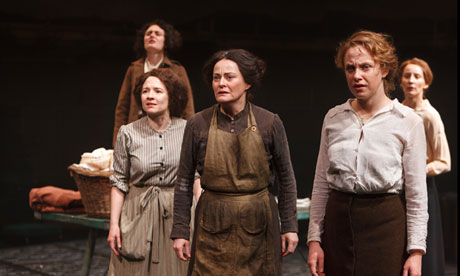
The Royal Exchange’s revival of Peter Whelan’s The Accrington Pals (17 Jan - 16 Feb),on its home turf so to speak, contrasts the experience of the men in the trenches of the First World War with the lives of the women at home.

Photo by Jonathan Keenan

The men volunteered for Kitchener’s new army in a spirit of bravado and comradeship, seeing the war as an adventure and escape from their daily toil.  Left behind, the pragmatic womenfolk of the mill town find themselves in a rapidly changing world that presents new hardships, opportunities and fears.
 "If there’s one thing that narks the men about this war its the way it shows them up for creating such mysteries round things.  My God! Providing both your eyes point forwards and your arms aren’t on back to front, anyone can drive a tram!"

Photo by Jonathan Keenan

The play is, by turns, poignant and funny and is underscored by dramatic irony; the audience is aware of the fate that awaits the men and the grief the women will face - but not meekly. Frustrated by rumour and newspaper propaganda surrounding The Big Push, the women of Accrington marched en masse to the town hall to demand the truth.

Photo by Jonathan Keenan

The cast are excellent, with great female characters shouldering the weight of the play, from Emma Lowndes as May, the single and independent market stall holder with her own private burden, to Sara Ridgeway’s ardent young Eva, Laura Elsworthy as the naive young mill girl, Bertha, Rebecca Callard’s earthy Sara and Sarah Belcher as the embittered Annie.

The Royal Exchange knows its space well and its set designs are always inspired. This time, designer Johnathan Fensom sets the scenes with  simple cobbles, a tram line, a market stall and a water pump. Being performed  in the round,  there is an immediate intimacy with the audience that a proscenium arch often can’t match. If you get the chance, go and see it.

Besides, you can’t go wrong with a theatre that looks like the set  for a TARDIS interior.


Thursday, 1 November 2012

We Will Remember Them

Today marks the ninety-sixth anniversary of the disappearance of the 13th Battalion of the Pennine Fusiliers.

On November 1st 1916, at Harcourt sector on the Somme, 900 men of the Broughtonthwaite Mates vanished in what became known as the Harcourt Event.

The Harcourt Crater, the biggest crater on the Western Front, is a lasting memorial to their fate, a fate film footage, found by a French farmer in 1926, would have us believe had them fighting for their survival on an alien world. 

Today in Broughtonthwaite, as for the past 95 years, wreaths were laid at the foot of the war memorial before St Chads at 7.30am, in memory of those who vanished on this day, at that time, in 1916.

The Heroes of Harcourt. We will remember them.


Friday, 19 August 2011

Tesla and the Tommies - Part 2

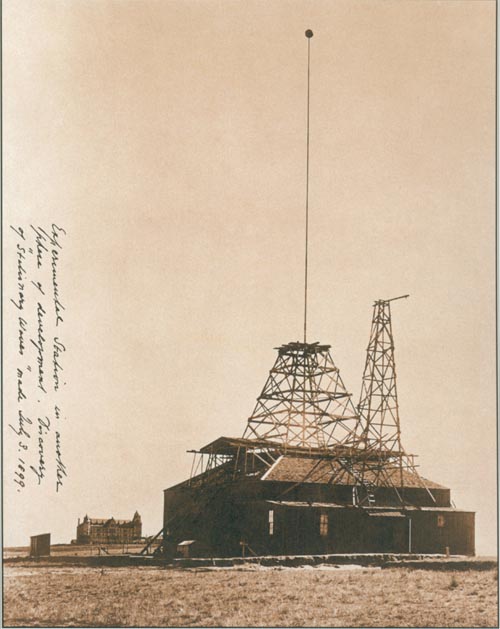
It wasn’t just Tesla’s theories about ‘death rays’ that the British Government were interested in. In 1899 Tesla claimed to have received faint radio signals from outer space on his array at Pike’s Peak in Colorado Springs and believed them to be a form of interplanetary communication.

 Tesla's Colorado Springs Laboratory
"The feeling is constantly growing on me that I had been first to hear the greetings of one planet to another."
-Nikola Tesla, "Talking with Planets", Colliers Weekly February 9th 1901.
Then, in 1926, the Hepton footage was discovered in a French field, along with the journals and letters that constituted the rest of the Lefeuvre find. The silent black and white film, depicting the Pennine Fusiliers apparently alive and on an alien world, was shown to packed picture houses around the world. If the Pennines really were stranded on another planet, it occurred to some in the War Office that there maybe a way of communicating with them. They urgently sought confirmation from Tesla. Partly financed in secret by the British Government, Tesla continued to refine his Teslascope in an attempt to contact the battalion by radio, hoping to detect a responding radio communication from them. No such signal was ever detected or, if it was, its contents have been kept secret to this day.

In the end, the Government officially declared the Hepton footage to be a hoax but nevertheless continued its clandestine funding of Tesla’s research for some years after, suggesting that at least one or two powerful political figures believed in the provenance of the film. But, in the early 1930s, Ramsay MacDonald's Government became disillusioned with Tesla’s progress and withdrew its support.

However, the fate of the 'Broughtonthwaite Mates' along with this early governmental research served to foster an underlying attitude within Whitehall that, in the 1950s, eventually inspired the Government’s decision to form the British Rocketry Group.

Monday, 1 November 2010

At the Going Down of the (Alien) Sun...

Ninety four years ago today, the 13th Battalion of the Pennine Fusiliers vanished from the Somme leaving, in their wake, a great scar on the landscape.

This year, for the first time in living memory, there will be no WW1 veterans gathered at the memorial in the nearby town of St. Germaine or laying a wreath at the site of the Harcourt Crater to remember long fallen comrades, comrades who found themselves, as the Hepton Footage would have us believe, on another world.

Their legacy may yet exist on that nameless alien planet and it may be that "They shall not grow old as we who are left grow old" at least, that is, if the theory of Relativity holds sway.

But today in Broughtonthwaite, at 7.30am wreaths were laid at the foot of the war memorial before St Chads in memory of those who vanished this day, at that time, in 1916.


We will remember them.

Monday, 14 June 2010

Hun Horror at Harcourt?

The Battle of the Somme had dragged on throughout the summer of 1916 and, in its dying days, at twenty minutes past seven on the morning of 1st  November, nine hundred men of the 13th Battalion of the Pennine Fusiliers, a Pals Battalion known as the ‘Broughtonthwaite Mates’,  went over the top.

Their objective was to attack the entrenched German machine gun positions in Harcourt Wood. It meant crossing over quarter of a mile of No Man’s Land, up a gentle incline that recent autumn rains had turned into a lethal quagmire. It was to be the last large scale attack of the campaign. In a bid to finally take and hold the Harcourt sector of the German line that had resisted the British advance all summer, the 13th Battalion marched resolutely into the gas cloud drifting across No Man’s Land to do their duty for King and Country.

And vanished.

The northern mill town of Broughtonthwaite, where the regiment had its barracks, was understandably devastated when the tragedy was reported by the local newspaper.

Broughtonthwaite Mercury, Thursday 2nd November 1916

As the town mourned its heavy losses, the relatives pressed for answers from a reticent Government.  Philanthropist and magnate, George Everson of Everson's Brewery, twice mayor of Broughtonthwaite and whose son, Second Lieutenant  James Charles Everson, was among the missing, brought considerable pressure to bear on the government.

In response, the War Office claimed that the Germans had set off mines dug deep below the British positions, packed with ‘an experimental explosive’. However eye witnesses at the time, as the cutting above illustrates,  claimed to hear no explosion that could account for such a catastrophic event.

It didn’t take long for rumours to spring up concerning the extraordinary circumstances of the Pennines’ disappearance. Some ascribed supernatural explanations. Others talked of Bosche Zeppelins and death rays.

Questions were asked in Parliament. The government stuck to its original statement, seeking to turn the tragedy into propaganda while secretly setting up a Committee of Enquiry to investigate the incident. Its eventual findings would be sealed for an unprecedented one hundred and fifty years. The families and descendants of those lost will have to wait until the opening of the records in 2069 to discover the official verdict.

Sunday, 6 June 2010

Over the Top

Along with the Angel of Mons and the Phantom Bowmen, the Harcourt Crater is one of the enduring myths of the First World War when, on the 1st November 1916, some 900 men of the 13th Battalion of the Pennine Fusiliers vanished from the face of the Earth.

Although many claims on the truth have been made, the Harcourt Crater and disappearance of the ‘Broughtonthwaite Mates’ have never been satisfactorily explained and with the deaths in recent years of the last surviving World War One veterans, there is now no one alive who can remember, first hand, the tragedy of All Saint’s Day, 1916.

However the publication of a new book, No Man's World: Black Hand Gang from Abaddon Books, has prompted a resurgence of interest in the ninety-four year old mystery.

Was there any truth to government claims at the time that the crater was the result of experimental explosives? Or was it, as some believe, the work of supernatural forces? Did Nikola Tesla appear before the secretive government Committee of Enquiry into the Harcourt Event and, if so, why?

For those interested in seeking further information about the Harcourt mystery and the true fate of the Broughtonthwaite Mates, your search continues here.