Showing posts with label War Office. Show all posts

Thursday, 10 November 2016

Weird War One: Electric Weaponry


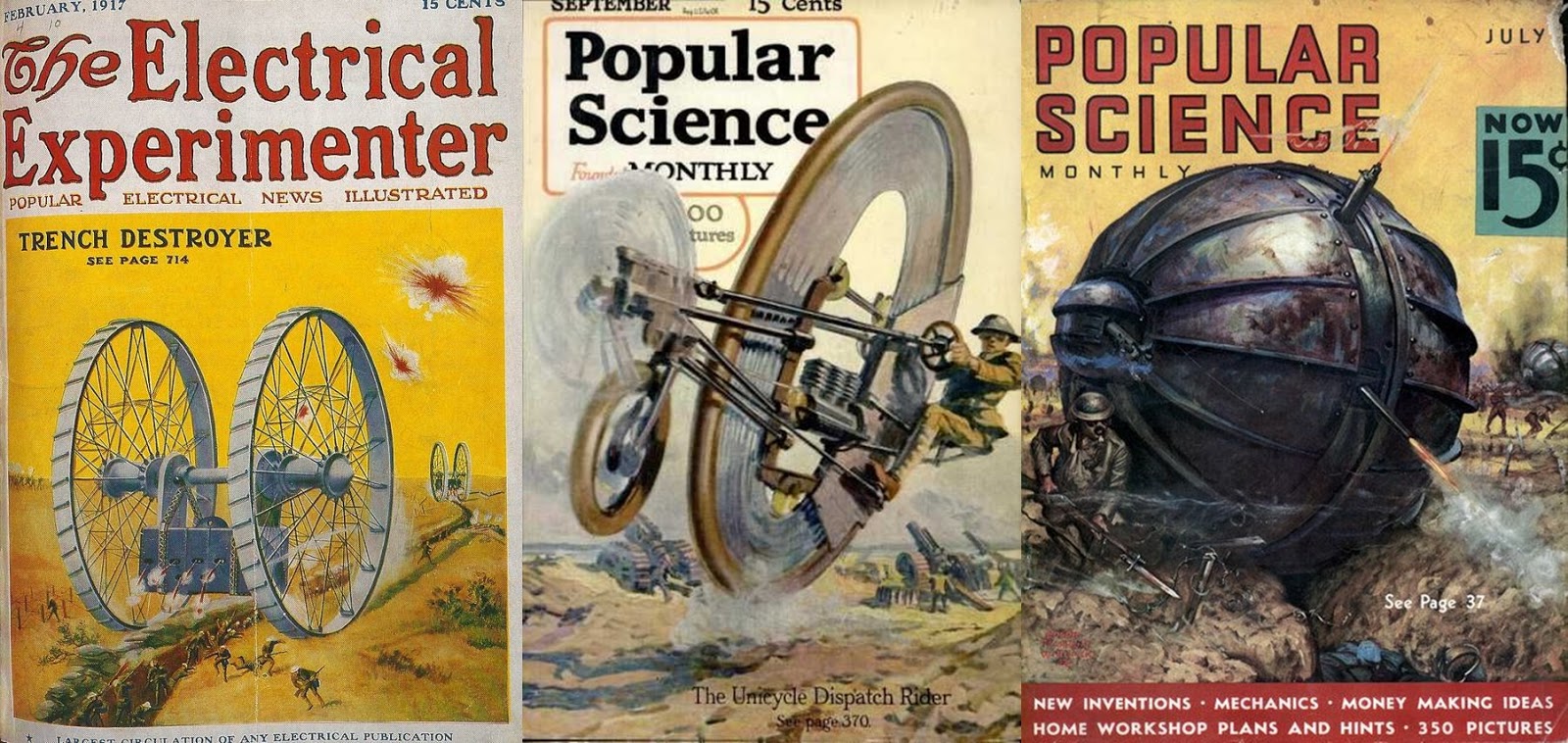
During the First World War, technology advanced at a great pace with machines and devices rapidly becoming obsolete as they were superseded by events or enemy technology.

The War Office was always open to new ideas for weapons that might give them an edge over the German army and many periodicals of the time were enthusiastically filled such with proposals, although a great many proved impractical.

There were persistent rumours that Nikolai Tesla was working on a death ray and, in England, Harry Grindell Matthews claimed to have invented a remote-controlled anti-Zeppelin weapon, for which the Admiralty allegedly paid him £25,000. After the war, in 1923 he, too, also claimed to have developed a Death Ray.

In No Man's World, the Pennine Fusiliers manage to supplement their diminishing supply of ammunition by adapting alien Chatt technology to create a rechargeable electrical weapon of their own. It was partly inspired by a proposed real world application. The June 1917 issue of The Electrical Experimenter featured an article describing an electrically-charged weapon for use again the Hun on the battlefield.


Adapting the German idea of the flammenwerfer, or flame-thrower, the idea revolved around  electrifying pressurised salt water or a sulphuric acid solution. The liquid tank carried by the soldier was attached by cables to a generator and transformer in the trenches that would deliver up to 15,000 volts. It was suggested that the rubber-clad operator could then fire a stream of electrified water up to 100 feet, stunning or killing the enemy. Needless to say the whole enterprise was ill-conceived, not to mention dangerous, and was never actually put into service.


Strange but true.

Thursday, 9 June 2016

The Monocled Mutineer Part 3 – The Burial

Ninety-six years ago today, on the morning of 9th June 1920, following an ambush by disguised policemen and a hastily convened inquest with unanswered questions, Percy Toplis was buried in Penrith.

But not even that was without its drama.

When a policeman arrived outside Penrith’s Beacon Edge hillside cemetery at 8 am, he informed the expectant crowd of Press that they had postponed the 9am funeral until 1pm because the coffin was not yet ready, so a disappointed press corps dispersed.

When they reconvened at lunchtime, they found a note on the cemetery gates informing them that that the funeral had already taken place. While their anger was directed toward the police for the deception, it was actually the Home Office and War Office that had decreed that Toplis should be secretly interred in an unmarked grave.


Penrith Police Station, where Toplis' body was kept

To that end, the police co-opted Harry Bartley, who owned a flatbed lorry. At 8.15 that morning, officers loaded Toplis’ coffin aboard the lorry from the Weights and Measure room of the Penrith police station, where his body had been kept, before covering it with rags, carpets and sacks. Bartley then drove up to the cemetery, half fearing that he might be followed or that the coffin would bounce off the bed of the truck.

He delivered the coffin to the cemetery chapel, where plain-clothes police officers intended to inter the body in an unmarked grave before anyone discovered their deception. However, cemetery parson Reverend Law insisted on conducting a full funeral service, arguing that the deceased had not actually be convicted of anything and any judgement should be left to Heaven, before leading the police in the singing of a hymn.

Only then was Toplis was then hastily buried in a grave plot  ‘listed as No. 7135… under a yew tree at the highest point of the graveyard’ according to Allison and Fairley’s book, ‘The Monocled Mutineer’.

Percy Toplis’ grave remains unmarked to this day, despite several campaigns to erect a marker.

However, despite the police and the authorities’ desire to bury the incident along with Toplis, he  continues to exert a fascination, even today, as fact and fiction meld into myth.

Next: The Monocled Mutineer – Controversy and Conspiracy

Friday, 19 August 2011

Tesla and the Tommies - Part 2

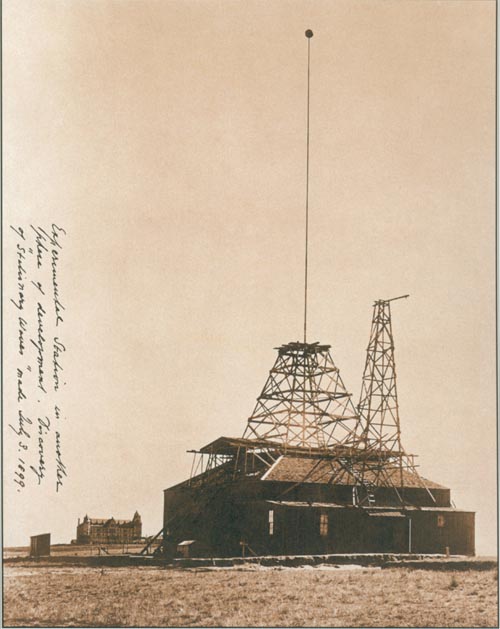
It wasn’t just Tesla’s theories about ‘death rays’ that the British Government were interested in. In 1899 Tesla claimed to have received faint radio signals from outer space on his array at Pike’s Peak in Colorado Springs and believed them to be a form of interplanetary communication.

 Tesla's Colorado Springs Laboratory
"The feeling is constantly growing on me that I had been first to hear the greetings of one planet to another."
-Nikola Tesla, "Talking with Planets", Colliers Weekly February 9th 1901.
Then, in 1926, the Hepton footage was discovered in a French field, along with the journals and letters that constituted the rest of the Lefeuvre find. The silent black and white film, depicting the Pennine Fusiliers apparently alive and on an alien world, was shown to packed picture houses around the world. If the Pennines really were stranded on another planet, it occurred to some in the War Office that there maybe a way of communicating with them. They urgently sought confirmation from Tesla. Partly financed in secret by the British Government, Tesla continued to refine his Teslascope in an attempt to contact the battalion by radio, hoping to detect a responding radio communication from them. No such signal was ever detected or, if it was, its contents have been kept secret to this day.

In the end, the Government officially declared the Hepton footage to be a hoax but nevertheless continued its clandestine funding of Tesla’s research for some years after, suggesting that at least one or two powerful political figures believed in the provenance of the film. But, in the early 1930s, Ramsay MacDonald's Government became disillusioned with Tesla’s progress and withdrew its support.

However, the fate of the 'Broughtonthwaite Mates' along with this early governmental research served to foster an underlying attitude within Whitehall that, in the 1950s, eventually inspired the Government’s decision to form the British Rocketry Group.

Wednesday, 30 June 2010

Missing in Action

The War ground on and the rest of Britain moved on with it. The suffering of the families in Broughtonthwaite though, continued, with parents, wives  and relations petitioning the War Office for news on their lost ones. Not for them the relief or grief of scouring the newspapers for familiar names in the casualty lists or the lists of dead. A confirmation of death would be a blessing compared to the agony of not knowing.

However, the War Office was unable or unwilling to give an answer. The extraordinary circumstances surrounding the 13th Battalion elicited no special treatment from the bureaucrats. The relatives were dealt with in the same brisk, business-like manner as the families of tens of thousands of other soldiers. The men were simply listed as Missing. Not Dead, or Died of Wounds, or Killed in Action, just Missing.

Reproduced courtesy of the Cooper family.

And that continued to be the official response until the Committee of Enquiry into the Harcourt Incident delivered its secret report. The men of the 13th Battalion were officially declared Dead in 1921 and the families of the Broughtonthwaite Mates had to take what little comfort they could in that.

Until the events of 1926, that is.